Lost in Translation, Found in an Orange Vest
I want to tell you that I navigated my first Jarasum Jazz Festival like a pro. That I studied the map, memorized a few phrases, and glided from the Gapyeong Station to the island without a hiccup.
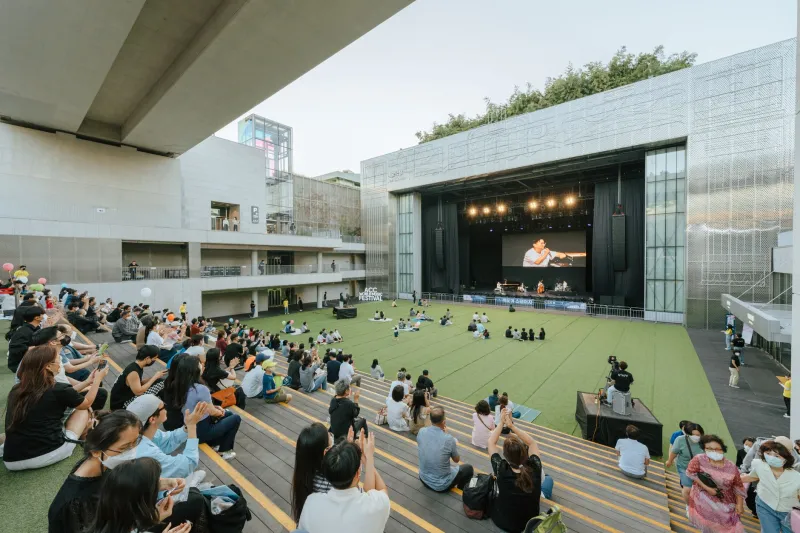
Here's what actually happened: I got off the train, walked the wrong direction for fifteen minutes, and ended up in a parking lot staring at a sign I could not read. My translation app was spinning. My phone signal had gone on strike. And somewhere behind me, a river I couldn't see was hosting one of the best jazz festivals in Asia.
That's when I met Mr. Bae.
The Orange Vests
If you've never been to Jarasum, picture this: hundreds of volunteers in bright orange vests scattered across Gapyeong like a human wayfinding system. They stand at train stations, ferry docks, food lines, and stage entrances. Students on break. Retirees with folding stools and thermoses. Shopkeepers who closed their stores for the weekend.
I assumed they were staff. They're not — or at least, not in the way we'd use that word. They're locals, mostly. And according to the festival organizers, they're not there to hand out wristbands and point at bathrooms. They're there to be, and I'm quoting a program note I photographed because I couldn't read it at the time, cultural ambassadors.
That framing matters. In the American festival economy, volunteers are often the folks trading a shift for a free ticket — valuable, sure, but interchangeable. At Jarasum, the volunteer corps is treated as part of the show. Organizers train them not just on logistics but on the festival's history, the artists, the neighborhood. The idea is that a volunteer isn't a checkpoint. A volunteer is the first local you meet.
For a lost American, that's not a nice-to-have. It's the whole ballgame.
Four Words of Korean and a Confused Face
Mr. Bae spotted me before I spotted him. I must have had the look — the slow head turn, the squint at signage, the general aura of a man whose plans had quietly collapsed.
He didn't open with English. He opened with a smile and a gesture toward my festival wristband, which I was wearing on the wrong wrist, apparently, because he gently moved it and said something that needed no translation.
Then he walked me to the ferry dock.
Not pointed. Walked. Along the way, in careful, self-deprecating English, he told me he was a retired middle school teacher who had volunteered at Jarasum for eleven years. He told me the best tteokbokki stall on the island was run by his former student. He told me which stage the wind usually messes with and which one the sound engineers love. He asked where I was from, and when I said Chicago, he nodded like we now had a shared history.
By the time we reached the dock, I had a hand-drawn map on the back of a receipt, a recommendation for the 6 p.m. set, and a new life goal, which was to be more like Mr. Bae.
Why the App Isn't Enough
Look, translation apps are great. I used mine constantly. But here's the thing an app can't do: it can't decide that you look hungry and reroute you past the makgeolli tent. It can't notice that the ferry line you're standing in is for the wrong dock. It can't tell you, with a twinkle, that the saxophonist playing at sunset once played a duet with the river itself, or at least that's how Mr. Bae described it.
The language gap at Jarasum is real, and it's wider than most US travelers expect. English signage has improved over the years, but the festival lives in a small river town, not a capital city. What closes that gap isn't technology. It's the grandmother in the orange vest who walks you forty meters out of her way because she has nowhere better to be and you clearly need a friend.
I watched it happen all weekend. Volunteers adopting stranded Australians. Volunteers negotiating with a food vendor on behalf of a vegan couple from Portland. Volunteers waving goodbye to the same visitors they'd rescued that morning, like old neighbors.
What to Actually Do With This Information
If you're an American planning your first Jarasum trip, here's the practical takeaway, and it's refreshingly simple:
Look for the orange. The vests are your lifeline. Don't be shy — asking for help is not an imposition here, it's the job, and honestly, it seems to be the joy.
Learn four words. Annyeonghaseyo (hello), gamsahamnida (thank you), eodiyeyo? (where is it?), and jal meokkessumnida (bon appétit, roughly). That's it. That's the whole phrasebook. Mr. Bae carried the rest.
Say yes to the detour. When a volunteer offers to walk you somewhere or tells you about a stall or a set, take the detour. The scheduled stuff is great. The detours are why you'll come back.
Thank them by name. Volunteers at Jarasum wear name tags. Use them. There's no tip culture in Korea, and these folks aren't working for one — but a genuine thank-you, maybe a photo together, lands harder than you'd think.
The Real Headliner
I saw some incredible music that weekend. A pianist who made the crowd go silent in a way I've only felt a handful of times in my life. A late-night jam session that spilled past curfew like it had diplomatic immunity.
But the moment I tell people about, the one I lead with at dinner parties, is Mr. Bae and his receipt-map and his eleven years of orange-vested service. Because here's the truth about festivals, especially ones you travel across an ocean for: the music is why you buy the ticket, but the people are why the weekend becomes a story.
Jarasum understands this better than any festival I've attended in the States. It doesn't just staff its grounds. It introduces you to a town. And somewhere between the ferry dock and the front row, between four words of Korean and one retired teacher's patience, I stopped being a tourist and started being a guest.
That's not something you can download. You have to show up, get a little lost, and trust the orange vest.